The Idea:
Bottle Lights
The Idea:
Bottle Lights
Liter of
Light was the first to implement bottle lights on a wide scale. The idea
took root quickly in the Philippines slums, and tipped over to other countries.
It was genius: take a n 2-Liter Coke bottle, fill it with water and a
little bleach, install it in a tin or aluminum roof and poof: you have a 50W
solar light bulb during daytime, rain or shine. Homes that previously had
no light would now be able to go about their daily activities much easier.
It seemed to make the most sense in densely packed slums, which had less
access to open space and daylight. Rural villages by comparison afforded
more space under the sun for people to work and study.
On a mass
scale, bottle lights have the added function of recycling and reusing thousands
upon thousands of Coke bottles. There are opportunities in the supply
chain, sourcing materials from in-kind donors as well as foundations and
corporate partners, in conjunction with recycling programs. The climate
conditions in Bangladesh are better even than the Philippines, due to stronger
and more prolonged sunlight. With the rapid urbanization across
Bangladesh, there is a large and growing number of people that would benefit
from this simple and cheap technology.
But all that
may (or may not) come in time. What I was focused on was completing a
successful pilot project—to get it right for one small community—before any
thoughts of scaling.
Groundwork
I shared my
ideas for Dia Bari slum with changemakers I knew to see who might be interested
in helping. Carole found links to two organizations in Bangladesh who
were already on the bottle light scene. One had tried in June during
rainy season, and failed miserably on its one and only installation; not only
did the bottle not provide enough light, but it had started leaking. They
paid for a new tin roof, dismantled the project, and redirected donor funds
elsewhere. I was duly warned.
The second
organization, CHANGE (www.change.org.bd), is a youth based
organization that had succeeded in installing bottle lights with good press
coverage. I had been interviewing a young social entrepreneur named
Anjali, who called CHANGE to set up a meeting. The founder and president,
named Sajid, is also a student, research assistant, and member of the national
fencing team. He heard about Liter of Light in January of 2012, and
started exploring the feasibility of doing the same thing in Bangladesh.
He made a few adjustments to the model used in the Philippines,
substituting materials found locally. After three months, he and
his team installed the first bottle. Sajid did not have the
resources to achieve the same scale as elsewhere, but he did produce studies on
the feedback of the slum dwellers, and won social entrepreneurship awards that
provided funding. CHANGE championed the cause in the media, and taught
students how to build their own bottle lights. Through these initiatives,
CHANGE became a Global Partner of Liter of Light.
As an
environmental research student, Sajid saw the bottle lights from an energy
perspective. He installed them in a slum where there was already
electricity stolen from the grid. The intention was for slum dwellers to
use less power during the day, saving energy and lightening the load on the
rest of the grid. But slum dwellers pay a lump sum for electricity
regardless of how much they use, and there was little incentive to abandon
their existing light bulbs for a bottle light. The only exception was
during load shedding times, where the electricity was temporarily turned off
for everyone to conserve energy.
Effectively,
they did not see the need for bottle lights. Moreover having it installed
in their roof made them feel poorer. Thus there was a lot of social
resistance from the slum dwellers. CHANGE conducted awareness campaigns
to convince the community of otherwise, with varying degrees of success.
All in all, CHANGE was able to install 30-32 bottles in 2 areas in its
one year of existence. Crucially, the bottles installed were structurally
sound, and did not leak in during monsoon season.
My approach
was from a different angle. I wanted to help the people in the slums
where there was no stolen electricity and thus little options. The
reasoning was that they'd be quicker to adopt the bottle lights, and not feel
poorer.
We thanked
Sajid for his time and arranged to go see CHANGE's existing pilot project in
the Mirpur slum of Baunia. A few weeks passed as we coordinated
schedules, and in the meantime I researched how to build a bottle light
from scratch, and planned the method of attack with my team. The problems
generally fell into two categories:
1)
Engineering quality lights
2) Gaining
acceptance among the people
The first
problem was more pressing; in no way were we going to install leaky lights and
make the situation worse. I wasn't about to go playing handyman on
someone's roof and ruin it. Sajid told us of another amateur project that
failed, an alumni organization that installed 70 lights in 7 days. They
too had quality issues because they used 1.5L bottles and cheap glue.
Smaller bottles meant less light and cheap glue meant leakage.
Feroz wanted
to buy some materials and start experimenting ourselves, but this seemed too
rudimentary, and neither of us were particularly good with our hands. The
other issue was how to test for leakage. Even if it worked on an
experimental shack, I couldn't guarantee that the lights wouldn't leak in 6
months.
I finally
settled on the simplest solution, which was to use Sajid's existing team to put
in the lights for me. Sajid's friend Mahmud from the national fencing
team is an electrician, and had installed the first bottle lights for CHANGE.
With electrical wiring around the slum roofs, the job had to be done professionally,
and CHANGE paid him for his efforts. He had the equipment and the
experience, and knew where to buy the materials. I could invite him to
help me do the same, and also hire an assistant from the slum who could help
out and be locally accountable for maintenance. Anjali called it the Plug
and Play.
Baunia
 Feroz came
along to meet Sajid and Mahmun, who brought us to Baunia slum to see the lights
they'd already installed. The first house we inspected was quite large by
slum standards, with a high ceiling and two rooms. One room had a bottle
light installed that provided decent illumination, enough that no other light
was needed. They still used an electrical bulb in the second room, which
had no bottle light. We checked four houses in total, and all the lights
worked fine. Other than a few collected cobwebs, they were in good order.
In another room, someone was sleeping in the light from the bottle: a
reminder that once installed, it couldn't be turned off.
Feroz came
along to meet Sajid and Mahmun, who brought us to Baunia slum to see the lights
they'd already installed. The first house we inspected was quite large by
slum standards, with a high ceiling and two rooms. One room had a bottle
light installed that provided decent illumination, enough that no other light
was needed. They still used an electrical bulb in the second room, which
had no bottle light. We checked four houses in total, and all the lights
worked fine. Other than a few collected cobwebs, they were in good order.
In another room, someone was sleeping in the light from the bottle: a
reminder that once installed, it couldn't be turned off.
There was
actually demand for 50 more lights in Baunia, as the idea caught on with the
community. This was encouraging for the longer term dissemination of the
concept. Sajid was looking for funding sources from various organizations
to help with the financing.
Back to Dia
Bari
The next day
I returned to Dia Bari slum with Feroz, exactly five weeks after my
first memorable visit with the HK team. Last time had been winter, but by
now the hot weather had set in, reflected in the numerous kids running around
sporting freshly shaved heads.
Nahid
convinced Joshim, one of the original drivers that went in with us the first
time, to tag along. He knew exactly where our slum was located, and could
also help build rapport with the community by reminding them of our last visit.
At Carole's suggestion, I developed dozens of pictures that the HK
group had taken of everyone, and handed them out as a gesture of goodwill.
Grownups and children alike loved seeing themselves in photo form, and I
watched the faces light up as they recognized themselves in a picture. Of
course, this also led to chaos as children and mothers fought to see the
pictures and claim their own.
Feroz and
Joshim explained our intentions to install bottle lights, and the idea was
well-received. Through Feroz as interpreter, I told Sunni's mother that
we were inspired to do this because we saw Sunni studying hard, and wanted to
help her achieve her dreams. We collected over 20 orders from the
community, and promised to return the next day to begin work.
First Light
I met Feroz
and Mahmun early in the morning, with the latter coming prepared with ladder,
toolbox and a bag of ready-filled bottles. The modified recipe used bleach instead of chlorine,
but it achieved the same effect. After buying some glue, we rickshawed
over to Dia Bari.
|
|
 |
There wasn't
a crowd when we got there, and more importantly, only a few kids were around.
Though it was a Saturday, many were still at school. We set up in
front of Sunni's house and got to work. Mahmun needed an assistant, who
we hired for the day from the slum. I helped Mahmun install the first
light, because I wanted to get hands on to know how it was done.
Initially it was slow going, because the tin was softer than Mahmun
was used to working with. But we quickly adjusted, slipping in extra
wooden beams under the roof for support.
The light
was up and ready by the time Sunni came home. Feroz interviewed her
mother, who wiped tears from her eyes as she spoke about how this light would
help her children. Sunni was less emotional and maintained her calm
composure, quietly thanking me with a smile.
We put in
four lights that first day. The twenty-odd orders we had collected were
down to nine because many of the people had misunderstood the first sales pitch.
They thought we were providing lights that could be used at night, not
during the daytime. Other problems arose that we hadn't considered,
mainly involving the role of the landlord. We needed to get permission from
the landowners, who potentially could charge the tenants more rent after light
installation. After some discussion, it was clear that this problem was
outside the scope of our work, and we continued on.
 The third
light we installed was in the home of an old lady. When I went in to check
on the setup, she was openly shedding tears of joy. Her story was
melancholy: her only daughter was now married and living with her husband,
leaving the poor mother on her own. Long lines were etched into her face,
the expression moulded by long years of worry and hard living. Living in
this slum with no one to care for her, she considered this light the most
beautiful thing in the world. She dried her eyes and placed her hand
on my head, brushing my hair back while blessing me in Bengali. It was an
emotional moment and I didn't know what to say, so I said nothing.
The third
light we installed was in the home of an old lady. When I went in to check
on the setup, she was openly shedding tears of joy. Her story was
melancholy: her only daughter was now married and living with her husband,
leaving the poor mother on her own. Long lines were etched into her face,
the expression moulded by long years of worry and hard living. Living in
this slum with no one to care for her, she considered this light the most
beautiful thing in the world. She dried her eyes and placed her hand
on my head, brushing my hair back while blessing me in Bengali. It was an
emotional moment and I didn't know what to say, so I said nothing.
Mahmun's
assistant had a 12-year old son named Akash. He'd been feeling sick all
morning, but by afternoon had recovered enough to invite me to see his house.
It turns out that young Akash was an inventor, taking the skills he
acquired from technical college and applying it to the small workbench in his
home. It was a boon that his house was one of the few in the slum to have
electricity. He showed us a rechargeable battery light that he built from
parts found in the garbage. This amazed us, and I gave his father some
money to buy the tools he needed to build more lights—new batteries, an
electricity meter and a soldering iron.

Changing
Direction
When we went
back the next day, we were greeted with bad news. Of the outstanding
orders, we could only put in three more bottle lights. The other houses
had three layers of tin roofing instead of one, which made installation
impossible.
There were
also no additional orders, the reason time and again being that people wanted
lights for the nighttime, not during the day. We couldn't well force our
solution onto them, and so Mahmun went to work on the last three orders while I
went to see how Akash was doing.
The boy
inventor had built two more lights, one using a CD as a backboard. He'd
already sold one for 70 taka. This was a low price because all the parts
were second-hand, but it was encouraging that he built and sold the light
proactively.
We made some
suggestions on modifying his designs, and gave him money for a prototype.
By the next day, Akash had completed two more prototypes. He
claimed that once he had the materials, it only took 5-10 minutes to construct
one light.
 We decided
to subsidize the cost of the lights instead of donating them outright (like we
did with the bottle lights). If we approached this as a social business,
it ensured that only the people who needed the product would pay for it.
The light cost 200 taka to make, excluding Akash's wages. He marketed
the lights for 100 taka each, and we would subsidize 150 taka, thereby earning
him a profit of 50 taka for his efforts. It wasn't a huge sum by any
means, but not bad for a 12-year old for 5-10 minutes of work. If we made
the lights any more expensive, then we couldn't compete with the cheap 'Chinese
lights' on the market.
We decided
to subsidize the cost of the lights instead of donating them outright (like we
did with the bottle lights). If we approached this as a social business,
it ensured that only the people who needed the product would pay for it.
The light cost 200 taka to make, excluding Akash's wages. He marketed
the lights for 100 taka each, and we would subsidize 150 taka, thereby earning
him a profit of 50 taka for his efforts. It wasn't a huge sum by any
means, but not bad for a 12-year old for 5-10 minutes of work. If we made
the lights any more expensive, then we couldn't compete with the cheap 'Chinese
lights' on the market.
I went with
Akash around the entire slum to show off his prototype light and collect
orders; by the end of the day we had 20 interested households. Of course,
we'd learned by now that minds could change quickly. There were also some
new problems to solve, mainly around how to recharge the lights. The
landlord was already hounding Akash's family for more rent due to higher
electricity usage, so it would be difficult to use Akash's home as a universal
charging station.
Production
The
following day I went to Akash and gave him funds for the first 15 lights.
The money had been provided by Chris and Inga, our German friends who had
previously volunteered with the blanket distribution. They visited Dia Bari the same day Akash
showed us his original built-from-trash prototype light, and wanted to
contribute to the cause.
It took
Akash longer than expected to deliver on the orders, in part because he was
constantly experimenting and making improvements to the designs. The
casing for the battery was also made from scratch out of wood, which took time.
His father helped to build the lights, and it looked to be a father-son
bonding experience.
After a few
days (and with some extra tools) Akash and his father had built and sold 14
lights. Of the 5 lights already installed, the feedback from our
customers was positive and encouraging.
Quality
Testing

I skipped a
day in the slum due to a rare episode of Dhaka rain, which provided an
opportunity to check if our bottle lights passed the crucial leakage test.
None of them had leaked, which was fantastic news. The ground of
the slum was still wet with mud, transforming it into a quagmire. I
couldn't imagine how bad the conditions would be during the monsoon season.
Akash had
further improved on the designs, and Sajid brought a light meter to measure the
luminance of the various models. Our battery lights fared well, though
not producing as many lux as a normal bulb. By the naked eye, we could
see the dramatic difference the lights made within the complete darkness of the
surrounding slum.
Lessons:
We started
out implementing a tried and true solution, in what I thought would be a cut
and paste situation. The bottle lights ended
up costing more to install, but were provided free for the people. Though
we were confident in the solution, empirical testing proved otherwise. We
ended up selling lower cost “Akash lights” to four times the number of
households.
People in
general tend to be resistant to change, and overcoming that inertia may take
years. There were suggestions of awareness campaigns and educating
the locals, who may accept the idea in time. But this also
assumes that the people don't know what they want. Once we had a solution
that met the actual need of the community (Akash’s night lights) the people
adopted it immediately. It was a stark lesson in listening to the market
and adjusting accordingly.
Not to say
that bottle lights is a bad idea; perhaps it is a matter of sequencing, and once
people's priority of nighttime lighting is taken care of, they can focus on the
next problem. For example, to save battery time on their night light they
may choose to install a bottle light.
Once again I
dove into this project headfirst, driven by the need to execute and finish
before my Bangladeshi visa expired. As it turned out, there are many
things that can't be rushed, and no matter how much discussion we had after
each phase, in the end we could only wait to see what the next day brought, and
react accordingly.
The bottle
light initiative in Dia Bari brought mixed results. Seven installations
is hardly something to brag about, but at least quality-wise, the lights didn't
leak. As the plastic
Coke bottles faltered, a homegrown solution arose to address the true needs of
the people. That seed was Akash, who
just needed an opportunity and a little water to bear fruit. Given the proper funding, guidance and
technical advice, he and his father built 30 lights with different designs and
sold them all in less than a week.
Empowering
Akash was an unforeseen result of Project Alo.
His ingenuity and hard work allowed him to earn extra money for his
family, something that he is happy about.
I hope also that the experience will widen his horizons about what is
possible if he continues to apply himself.
All in all,
we were able to provide light of some form to about half of the households in
Dia Bari. Not bad for a start, but it
fell short of my aims to light up the whole community. I did however overachieve my original goal of
helping Sunni, by providing her house with two lights. This way she can study at any time.
The actual
budget of the project is laughingly small in the grand scheme of things. I could’ve easily paid for the whole thing out
of my own pocket, but the surplus donations from Blanket Drop and contributions
from Chris and Inga were enough to cover all costs.
Time was the
commodity we didn’t have, and even if given a few more days we would’ve made
the solution more elegant and complete. There
were still design adjustments that needed to be made to Akash’s models,
specifically in making the lights easier to recharge. We made the proper recommendations, but I
couldn’t personally oversee the project anymore. My visa was expiring and I needed to leave
the country.
 |
| With Sunni and Akash |
The Slum Kids
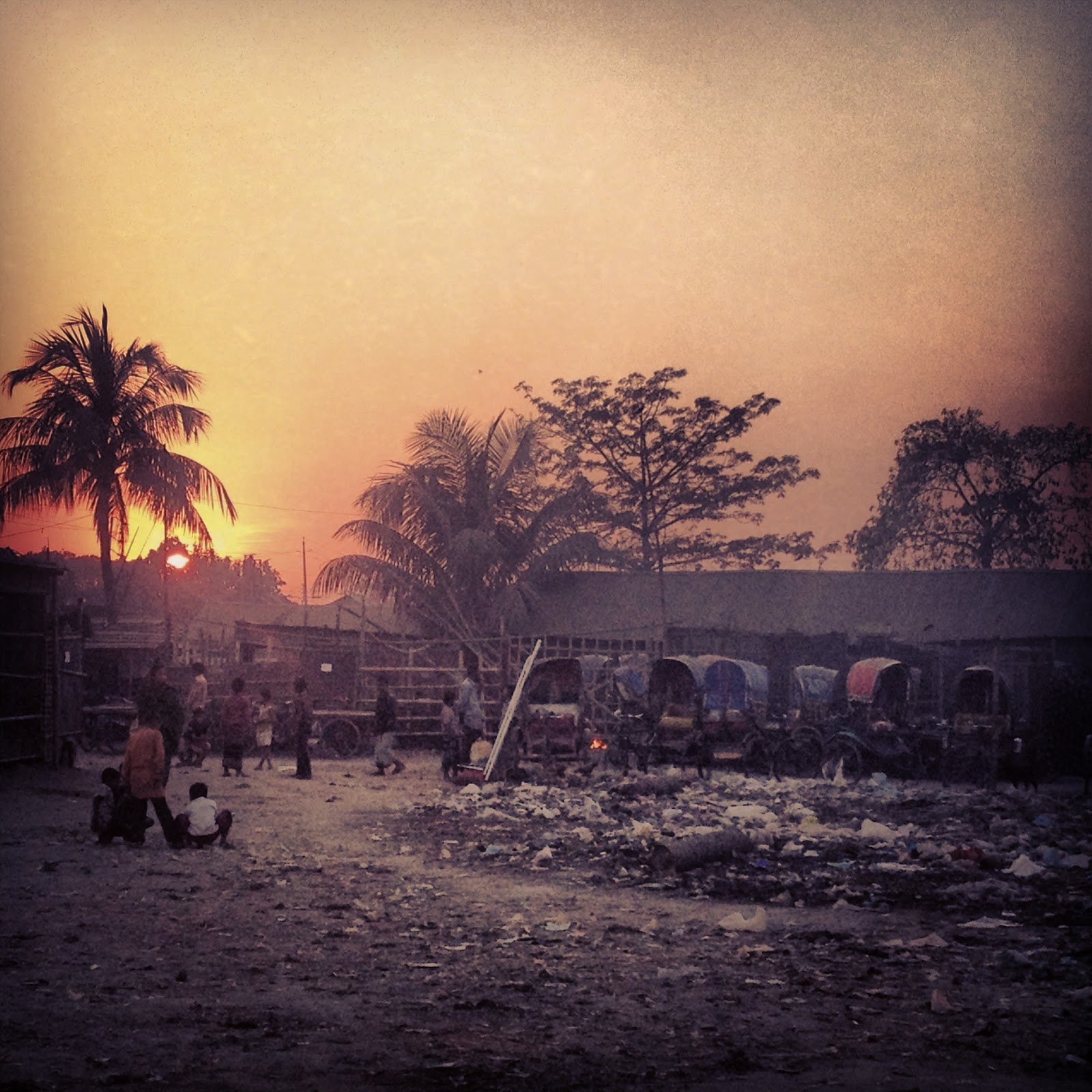
Every day I was in Dia Bari I was surrounded by the children. All the youthful energy that had surrounded the HK study group during our first visit was now directed solely at me. They pulled at my clothes and jumped on my back, held my hands and smacked me when I wasn't looking. This often slowed down and hindered my passage through the slum, though when it came time to work, the kids did back up and watched from a respectful distance. I did make sure to make room for playtime with them each day, and even played cricket with them, next to the pool of garbage. It remains the only time I ever played cricket.
There was a steady barrage of children and parents alike asking for their picture to be taken. Some of the older girls caught on that I was taking only one picture of each person, so they kept finding new toddlers for me to snap, conveniently standing in the frame to get more shots in. I for my part continued developing the photos to hand out, so that everyone could have their own. I also brought treats for everyone: one day it would be pears, another it would be cookies. Distribution of anything remained a gong show, but I got somewhat used to it by the end.
These kids had defined our first visit. Their energy and enthusiasm were contagious, and had left us welling up with joy. Through Project Alo I was able to experience this for an extra week, and it made everything worthwhile. Ultimately it was the kids that I wanted to help, whether they understood it or not.