A
cold wave hit Bangladesh on the 7th of January and plunged the country into its
coldest temperatures in 40 years, down to 3 degrees Celsius in some areas.
The people in the rural and remote regions especially were not
well-equipped to handle the spell, and 82 people across the country died within
a week.
When
this happened, I had just returned to Dhaka from Jessore feeling ill, in sore
need of rest after weeks of nonstop travel. During the coldest days I
stayed mostly in my hotel room, and when I reluctantly stepped out into the
city it was biting cold, but not life-threatening. Dhaka is roughly on
the same parallel as Hong Kong, so the winter is comparable. As a large
city it would certainly be warmer than in the villages. But the fact that
people were dying preventable deaths in this weather was terribly sad. I
was sick myself and felt weakened in the cold, but I had warm clothes and a
blanket inside the comfort of a hotel. I couldn't imagine what it would like to
be ill-equipped in the open fields at the mercy of the wind.
Inception
I
met Feroz the day after most of the team left. Clive stayed behind
for one more day, and he had lunch plans with Feroz, with whom he had mutual
friends in the social world. We all went for a delicious home-prepared
lunch at the house of Feroz's relative Mintu, and politicked for several hours.
Feroz provided a unique perspective on politics and development in
Bangladesh, different from the Grameen and BRAC narratives to which I'd been
exposed.
After
that, Feroz and I kept in touch and during the first days of the new year, he
showed Carole and I around in Dhaka University and Dhaka Zoo. Though he
does have an infectious laugh, Feroz tends to be on the serious side,
especially when he pinpoints some problem or flaw in the system that must be
fixed. Born into a military family, he went from "farm chicken"
to hard-headed youth under his father's authoritarian parenting. He
eschewed medical school to study sociology in Dhaka University, but it was in
student politics where Feroz found power. He immersed himself in the life
for a few years and attained a high status within his hall, with troops at his
beckon. This proceeded until a close encounter with a rival faction led
to a near-death experience. Examining his life then, it became a turning
point that led to a complete reversal of his life. He went into a
self-imposed exile to cleanse of his former corrupt ways and begin
anew.
Feroz
then joined the Rotaract Club of Dhaka University, where the managerial and
administrative skills he'd picked up in politics served him well. It was
here that he began his social and development work focusing on young people,
serving in various leadership capacities over the last 12 years.
Since then, he's been at the head of Lifelong Education And Development
(LEAD), a network of 300 youth leaders across Bangladesh that focuses on
"developing young minds for global peace through education on good
governance, human rights, access to justice and other relevant issues."
After
the cold wave hit, on 10th Jan Feroz put out a plea on Facebook:
"Bangladesh experienced 45-year low temperatures killed at least 70 people
international online news (reporter Yang Wei Ming): 10th according to
Bangladeshi media the dawn daily reported that Bangladesh temperatures dropped
sharply over the last week, 45 years to the lowest temperatures, resulted in at
least 70 deaths, deaths were mostly children and the elderly. 9th Dina are the
pool region in northern Bangladesh meet the minimum temperature for 45 years,
3.2 degrees Celsius. Bangladesh Meteorological Department Deputy Director
Shahe·alamu said that currently this cold snap will continue for two, then
temperatures will rebound.
But after the 20th of this month, the country will celebrate the winter
cold spell during the second. Shahe·alamu also said, is located in the
subtropical regions of Bangladesh lack experience and prepare to respond to
cold, so the sudden cooling will result in more deaths."
"Bitter cold in Bangladesh. Some part of
Bangladesh experiencing 3 Degree. Many poor people died last few days. Need
more winter cloths for them. Some of our young volunteers collecting winter
cloths and donating to that area. Please donate your extra cloth ASAP."
Carole
had gone back to Hong Kong by this time, but she and I both answered Feroz, and our newfound friendship immediately became partnership as the planning started. If the next cold wave was coming on the
20th, and we wanted to put blankets in people's hands at least the day before,
then we had 9 days. We reached out to the EfG team, who would raise
funds in Hong Kong. Feroz would handle local distribution through his
youth network and political connections, whichever district we
chose. I would advance the necessary funds first due to time
constraints, and reach out to the Grameen interns as well for support in
any form.
Time
was ticking.
Planning
Since
the number we'd be distributing wouldn't be huge, we decided to focus on one
area. In the next few days, we considered six different districts and
evaluated our options in terms of logistics. All the areas would be in
need, as the number of people affected by the cold numbered in the millions
across the country. We finally settled on Shagata in the northern district of
Gaibandha, focusing on the people living in the char areas.
Char
(or chor) is the term for lowlands in regions of Bangladesh that are habitable and arable during dry season, but
entirely engulfed by the raging waters of the river during wet season.
This is not uncommon in Bangladesh, where 80% of the country is lowland,
only meters above sea level. Land erosion constantly changes the
landscape of the country, and once-rich landowners could have everything wiped
out in a day. The people build houses and settlements in the char areas
because there is nowhere else to live, and every year they watch their homes
destroyed, as they head to higher ground or build new temporary homes on
bamboo supports.
These
were the 'hardcore poor', even in Bangladesh.
 |
| The char people |
We
looked to Grameen Uniqlo at first for low-cost blankets, but unfortunately they
had stopped production for the season and had no stock. We then got some
samples from Grameen associated factories, which were inexpensive but of lower
quality. The blanket was too thin and frayed easilyy. Finally we found
some samples of export-quality blankets, of a soft polar fleece type material.
These were much heavier and of better fabric. We negotiated down to
220 taka (USD2.75) per blanket, and ordered 800. Through the interns at
Grameen and especially Kei from Japan, we were able to increase the number to
over 900.
The
mechanism of distribution was crucial. We needed to efficiently pass out
blankets while maintaining order. There was precedence for conflict and
violence among the people as they scrambled to get blankets. Feroz had
also once tried throwing blankets from a vehicle to homeless people sleeping on
the street. People would then run after the truck collecting all the
blankets. We looked at a token system whereby volunteers would pass out
tokens among the villages, one per house and the people would come to
designated spots to collect their blankets in exchange for a token. Local
political leaders would provide information on where the poorest were, but this
wasn't always reliable.
Finally
Feroz proposed that we go through the schools. The
people who were dying most from hypothermia were children and the elderly.
Every family would have both, so by going through the schools we could
ensure the families would each get one, and the blanket would go to whoever most
needed it. We would also have student lists from principals or teachers
to keep it honest. Or so we thought.
Feroz
came up with the idea and name for the Hong Kong Bangladesh Friendship Society,
and we envisioned the flags on the banner from the very beginning. It
made for a nice picture. He had some of his young fellows at Dhaka
University design and print the banners, including a smaller one to represent
Japan and their contributions. The Japanese flag side by side with the Bangladesh
flag is fitting, and well represent the close and friendly ties between the two
nations and peoples.
Before
we placed the order, we went to the factory to see if the goods matched the
samples. We took all the blankets they had, and ordered a few hundred
more to be made with a better material. I went to the bank to take out
the cash, and ended up at the ATM withdrawing the maximum per transaction limit
of 20,000 taka, eleven times. (This alerted the security and fraud
department at HSBC and they froze my account, I would later find out.) I
stuffed the stacks of notes into a manila envelope, then looked around as I put
it into my bag and headed to meet Feroz. I'd handled larger sums of cash
before but compared to my daily living costs here, it seemed like a lot of
money. I still had some hesitation when I handed over the money, but
we'd come too far.
Pick
Up and Delivery
I
decided to make the pickup and night trip up with the truck to Gaibandha. I wanted to personally ensure the quality and
quantity of the blankets, and make sure nothing happened to them along the way.
The rest of our team would go by two cars in the morning and arrive in
the evening. I started out from the hotel at 2:00pm to get to the truck
station at 3:00pm. Feroz sent one of his young fellows, Ikram, to meet me
at the truck station and accompany me so I'd have a local contact in case I
needed translation. Even though Ikram had an exam in two days, he still volunteered for the 12-hour ride up and the 8-hour ride back to Dhaka the next morning. He
was a true soldier for the cause and also very enthusiastic, almost cheering
every time I spoke Bengali.
But this also meant we both had to ride stuck in the middle between the truck driver
and his assistant. It was incredibly tight, and no position I sat in was
really at all comfortable. Ikram had it worse, as he had to sit with one
leg on either side of the gear-shift. The assistant's job at the window
seat was to loudly heckle all the vehicles that we were passing to get out of
the way, though why they wouldn't use the horn like everyone else was beyond
me. He also served to warn the driver about speed bumps, a vital function
as it turned out.
We
drove an hour from Dhaka to Ashulia where the factory was, and it took another
hour to load and secure the goods. I had gone there fully intent on
counting every blanket, but since they came in bundles of twenty it made
calculations easy. Leaving the factory at 5:00pm, we technically
should've made it to Gaibandha around midnight. We went the first four
hours without stopping, and when I wasn't talking to Ikram, my thoughts were
with my newly born godson Sebby and his family. By the end of that long
stretch, it got to the point where I couldn't sit still and changed positions
every ten seconds to try and get not uncomfortable.
Finally
we arrived at a truck stop and had dinner. After that, stops were more
frequent, the engine stopping a few times. At around midnight, the driver
stopped the truck and immediately passed out. There was nothing to do but
jump out, take a break and let the man catch a nap. I'd rather we get
there late than have him drive dead tired. I also wasn’t eager to get
back into the damn truck.
So
we took tea at the stall across the road and watched some horrible Indian
zombie movie. Everyone had a good laugh at how cheesy it was though.
After the movie ended we were back on the road, and it was my turn to
finally sleep. We almost got into an accident, and the assistant yelling
and the driver slamming on the brakes jerked me into semi-consciousness.
We barely missed hitting the vehicle in front of us. I then went
back to sleep. We finally got there at 3:00am after a 13-hour odyssey.
The
Char Schools
I
woke up after four hours of sleep to a beautiful sunny day, and convened
with the rest of the party:
- Feroz's long-time local collaborators Mintu,
Daizy, and Rahman
- Kei
and her friend Naoki visiting from Japan
- German volunteers Inga and Chris, who Feroz was
hosting
Mintu
is friends with the police superintendant of the Gaibandha district, who
personally got involved with the effort once he learned about it. He
escorted us along with half a dozen of his men to keep the order and prevent
chaos. Cutting an imposing figure, the man
was used to having his orders followed, bellowing out commands left and
right. I was later surprised to hear him speaking at a normal volume.
The
road to the chars was elevated a few meters above the rest of the land,
much of which was used in rice plantation. If I wasn't told, I would have
no idea that the lowland that stretched almost to the horizon would be
submerged in water, and that what I was seeing was the riverbed.
The
uniformed policemen with wooden sticks seemed superfluous as we pulled into the
first school. The kids had all lined up
in orderly fashion and the national flag was flying. We set up a table to pass out
the blankets one by one, moving bundles from truck to table. Soon a
square formed with the mothers and younger siblings looking on. This simple system worked well for about ten minutes, and some of the students thanked
us, saying 'as-salam alaykum' as they received their blankets.
Unfortunately,
a few kids slipped the front of the line, and all of a sudden everyone rushed
forward, surrounding us in a din of children and mothers. The teachers
and policemen attempted to maintain some semblance of order, the latter using
more forceful means than I thought necessary. Some members of our team who
spoke Bengali refused or pulled kids out of the line who were
double-dipping, and those clearly too old to be attending this school.
Feroz later told me that this was the hardest thing to do—telling someone
they couldn't have a blanket. I'm glad I wasn't making those decisions.
I'd seen the kids jumping the line, and the pensive mothers placing
their toddlers in the table’s vicinity, but I couldn't turn them away myself.

By
the time we left, there was no order remaining, only a crowd. I scanned the sea of faces and detected
mostly confusion, which in turn confused me. We beat a hasty retreat and
headed to the second school, which was much smaller. It held three
classrooms, and it was a simple job of handing out a blanket to each student in
the school. We had more time for photo opportunities and interaction with
the kids, but outside there amassed about twenty or thirty mothers holding onto
toddlers that wouldn't get a blanket if their child did not attend
this school. Alas, there is no such thing as a perfect system, but the
second stop was so smooth that I thought we might've figured out the formula.
Except
that the third school had amalgamated students from four different schools in
one area to save transport time. We couldn't get to the school by truck,
and had the blankets transferred to bicycle wagons, the final stretch carried
on foot. The children were lined up in rows on the grounds outside the
school, which was fine. But because there were so many students, the teachers
decided to put all the kids of one school into a classroom and have them come
out one by one and pick up a blanket on the way past the door.
Having
sixty or eighty kids of different ages in one classroom is already a bad idea,
but somehow there was no adult supervision in the room. We heard the
screaming and chaos before we even saw them. The kids were like caged
animals, waiting to burst out and excited about their new gifts. When
they saw the blankets they stampeded the door, and some of the smaller kids got
trampled underfoot. Children were walking out crying painfully, not even
caring if they got a blanket or not and looking only to escape. It was a
sickening sight to watch.
Since
I wasn't the one handing out the blankets, I walked off to see how the kids who
already got their blankets were getting on. They seemed much happier and
were generally more responsive than the first two schools. The
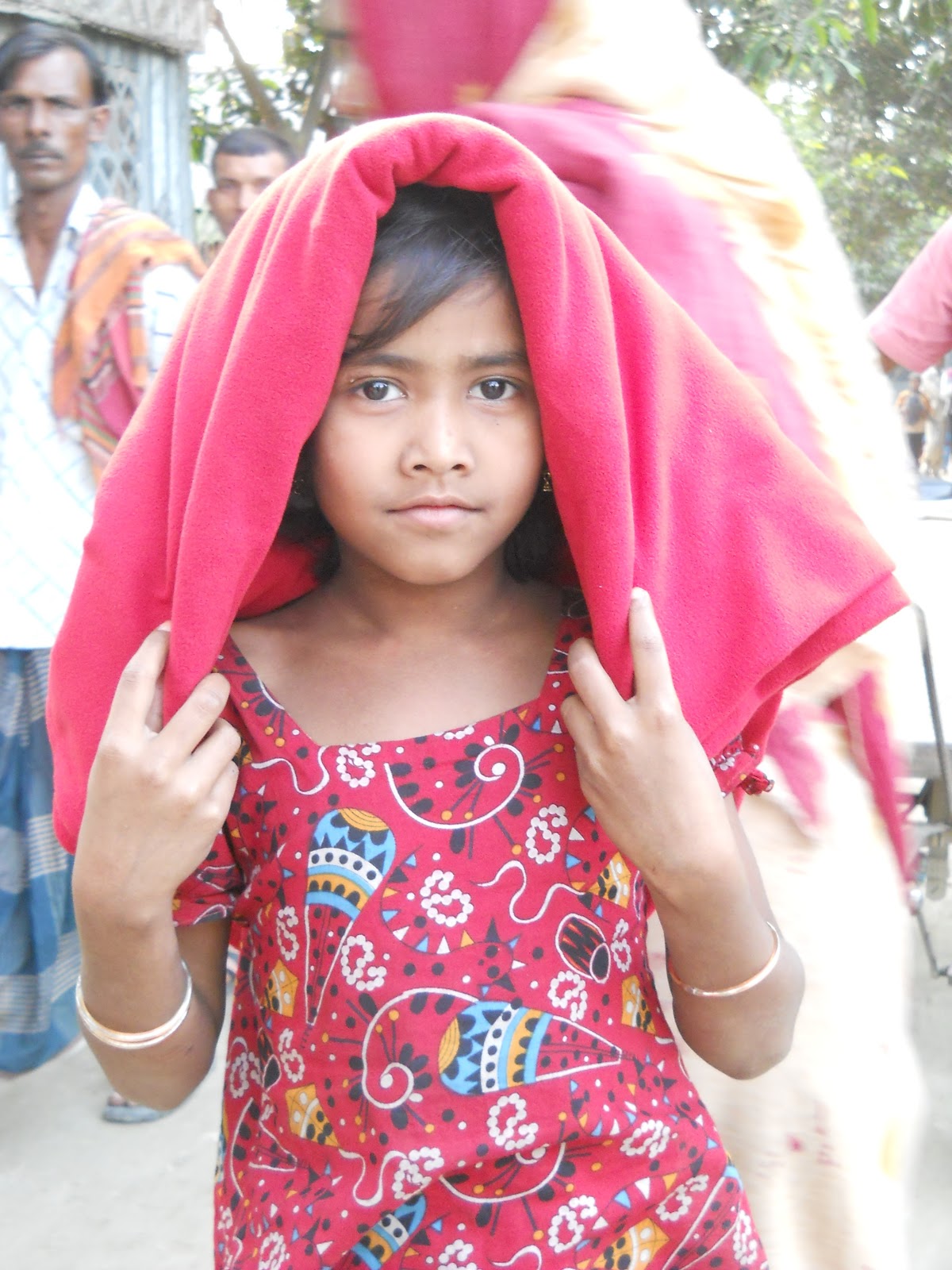
students happily posed with their blankets, and wrapped themselves in them. But
amidst the smiles and toothy grins were also faces that had much sorrow written
on them, young eyes that had seen a hard life of suffering.
 |
| The smiles made it all worthwhile |
However,
as far as our efforts went, all was well that ended well, and as we left that
last stop I looked back at the hundreds of children hugging onto their
blankets, or handing them to their waiting mothers, or wearing them like capes to
run after us. It finally felt like we were doing something good, and for
a moment it was okay to not feel guilty about all the people I saw and couldn't
help, or those who would die in the upcoming cold wave.
Feroz
was the happiest I've ever seen him. More than anyone else he worked the
hardest on this project, and yet he was content to give all the credit and photo
opportunities to others. He was an incredible partner to work with and I
really appreciate his dedication and attention to detail. He'd even
been sick during the planning process, but didn't allow it to affect him.
The
Last School
We
had blankets left over, so the next day we decided to distribute them to a
nearby NGO-run school before making our way back to Dhaka. This last
school was named after a famous Bangladeshi lady poet Suphia Kamal, who was
known for her advocacy of women's rights. It was by far the most organized
and orderly of all the Gaibandha schools we visited; though we'd given them
short notice, they had a welcoming party ready for us with bouquets of leaves
in hand. After a quick tour of the classrooms to chat with the students,
we invited the nursery, 1st and 2nd grade students to come out into the
schoolyard. They had a playfully light military routine to get
everyone in formation. We quickly distributed blankets to them, and I
spent some time with the older kids who had just arrived for their classes.
All they could say to me was 'Hong Kong, Hong Kong', so I had them
chanting that for a while. They pointed at my ripped jeans and said
'fashion, fashion' but I told them they were just ‘old, old’ and that
mosquitoes bit me where the holes were. That got them laughing.

Aftermath
Press
releases were drafted by Feroz and sent to a local Bangla and national English
newspaper. On 23rd Jan the article (http://thenewnationbd.com/newsdetails.aspx?newsid=64034)
appeared on page 3 of New Nation, an English-language daily.
The
warm weather held out for a few more days, and the cold came on 25th Jan.
Temperatures in the north dropped to as low as 4 degrees Celsius, though fortunately this time the cold wave only lasted two days. People were also much better prepared, though 8-10 people still died.
It's worth nothing the other efforts that were made to alleviate the cold, and the actual size of the problem:
"The Department of Disaster Management (DDM), Ministry of Disaster Management & Relief and the Prime Minister`s Office along with UNDP, national and international NGOs, Red Cross/Red Crescent, and Dutch-Bangla Bank have distributed over 644,000 blankets to reduce the sufferings of cold wave victims...However, the gap analysis undertaken by the Department of Disaster Management with assistance from UNDP Early Recovery Facility reveals that additional 1.5 million households are still in need of blankets and warm clothes to minimize their suffering." (http://reliefweb.int/report/bangladesh/undp-complements-national-efforts-minimize-sufferings-cold-wave-victims)
As a Canadian, I was happy to learn that Canada did their part as well, "providing 39,000 blankets to 15,000 families suffering from unprecedented cold weather in Bangladesh through immediate assistance from the Canadian International Development Agency (CIDA)."
Skeptics may say that in hindsight it was a wasted effort to provide blankets to those who didn't end up really needing them. I would say that we executed on a plan based on the consensus weather forecast, but that our plan was set against the backdrop of a bigger picture. The entire effort was based on the hope that more people would be warmer for the cold wave that was surely to come, on the hope that less people would die by hypothermia. We ourselves could only help 900 families, a mere drop in the ocean, but the weather itself defied all forecasts to keep the people warm. As is the case in the rainy season, the people of the char are at the mercy of the elements, and live or die by the will of God. In this case, I think God heard the prayers.
It’s
now time for the home team to play, and the guys and gals in our EfG study
group are working hard to raise money for the cause. A Facebook page has
been created showing some truly moving pictures of the children, pictures that
speak for themselves, invoking emotions of warmth and hope. At the EfG
event on 29th Jan the HK team had a fruitful discussion on their thoughts and
experiences in Bangladesh, and did some fundraising there.
A second proposed fundraiser will involve some of our members swimming
outdoors in cold temperatures, to simulate what it might feel like in the northern Bangladeshi villages.
However,
there are still some hurdles to overcome, mainly along the lines that we aren't a
registered charitable organization and can't publicly solicit donations.
I do have faith in my team and in Hong Kong. I am positive that it will all work
out just fine.
To
debrief, Operation Blanket Drop wasn't a social enterprise at all, more a
relief effort in the traditional charity sense. From a business
perspective it actually had terrible cash-flow. But while it may not have been social entrepreneurship, it certainly was a step in the direction of making change, and it felt like something that needed to be done. I'm thankful that the whole
process was relatively smooth, and I learned a lot about what goes on behind
the scenes for even so small an effort as this. It was fulfilling to work
for the people, and to deliver on a plan.
As
for the people of the char area, my heart goes out to them.
I was lucky to visit their area on a very nice weekend, and could only
imagine from the descriptions what it's like in the cold, or even worse during
the monsoon season when they lose their homes. I am under no illusions that
what we've done has changed lives in the long run. However, I do take
comfort that we provided the families with high-quality blankets that will last
them several years. And I hope that more
awareness can be raised about these areas, as there is little to no available
information on the Internet.
Now, if only a proper solution could be worked out for the rainy season, that would be
something!
Edit: As of 28Feb2013, we've successfully raised all the necessary funds for Operation Blanket Drop. There's even a small surplus that will go to the next projects.